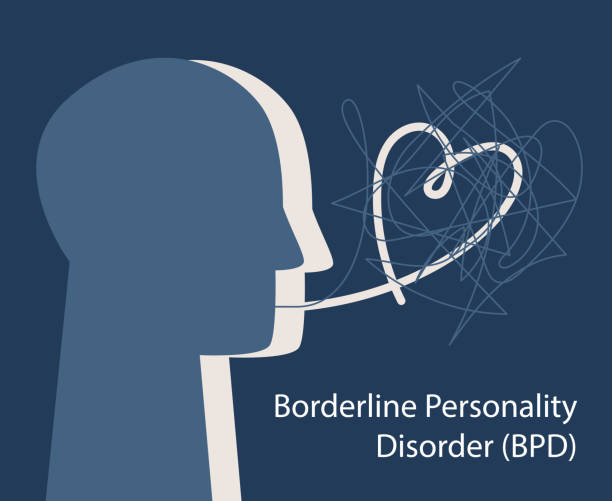
There are three levels of personality organization: neurotic, borderline, and psychotic. One of these develops in a child during the first six years of life. To put it simply, early infancy trauma can develop into the most primitive, psychotic level; an Oedipal crisis between ages three and six can develop into a neurotic level; and if a child experiences some kind of trauma between ages one and three, they are labeled as borderline. Previously, this level of functioning was considered a transitional state between excessively anxious neurotics and psychotics who have lost touch with reality. However, later, thanks to the efforts of psychoanalyst Otto Kernberg, it was classified as a separate category.
To understand the inner workings of a borderline person, let’s recall what a teenager experiences. It’s a storm of emotions and the onslaught of loss and suffering. It’s the overwhelming experience of unrequited love or, conversely, the breathtaking intensity of infatuation. Puberty—intense, categorical, and uncompromising—is accompanied by a poor understanding of ourselves and others. We see the world in black and white, finding it difficult to cope with anxiety and contain rage. When we’re in love, there are no boundaries—we long to merge with the object of our love into one. And separation is like a small death, because in our beloved, we saw both our support in life and the meaning of existence.
So, a “borderline guard” is an adult stuck in puberty. French psychoanalyst Alain Héril used the following metaphor: “The borderline guard lives in a large, beautiful house, but this house is built on shifting sands, and at times it feels as if it doesn’t even exist.” Why does this happen? The answers are in the carousel.
For brevity, we’ll use the word “borderline” throughout this text, but we’d like to remind you that it doesn’t refer to people with BPD—borderline personality disorder. This diagnosis doesn’t necessarily accompany someone with borderline functioning.
How are “border guards” created?
Two points are important here. First, the child doesn’t learn to be alone and act independently. During the early years of life, the child is fused with the mother, but to gain independence and autonomy from the parent, they must undergo a process that psychoanalyst Margaret Mahler called “separation-individuation.” But if the parent sends confusing signals—for example, suddenly disappearing or harassing them—the child finds themselves in an emotionally unstable situation. They grow up and develop in a borderline environment, and as an adult, they will continue to feel unstable and conflicted around others.
Violation of boundaries
This is the second factor that shapes the future “borderline guard.” For example, as a child, they might have been drawn into adult family situations as an arbitrator or protector, or they might have occupied the wrong place in the family hierarchy. The inner need to defend oneself and one’s boundaries resulted in intense anger, but how can one express it if one is not allowed to be angry with an authoritarian adult when one is weaker? And then all the aggression is repressed and accumulates within.
Refusal to recognize prohibitions
The borderline level implies an unresolved Oedipal conflict. This means that, while competing with the parent of the same sex for the parent of the opposite sex, the child was unable to accept the limitation: the parent of the opposite sex does not belong to them.
In the family, this was the result of a situation where, instead of clear rules, there was the authority of the strong. If the adults’ attitudes were disorienting, the child was forced to establish the law themselves. In such a situation, the ego is poorly structured, and the ideal ego will function in place of the superego. This ensures a perpetual struggle between the good and the best, in which the “borderline” is dissatisfied with any outcome—especially with himself. Another scenario: the child initially disregards the rule, and then becomes arbitrary.
Relationship with yourself
The “borderline” struggles to find answers to the questions “Who am I?”, “What am I like?”, and “What am I doing?” They struggle to establish an identity, that is, to find a stable, albeit changing, sense of self. Here, we can speak of diffuse identity, where the contradictory parts of the self are not perceived as a unified whole.
For example, after making a mistake, a person blames themselves: now they’re unequivocally bad—but they fail to consider that a single mistake doesn’t make them bad overall. But because of black-and-white thinking, they see themselves as either super-good or super-bad—and they view others through the same lens. They don’t feel whole—that is, capable of being different—and therefore their descriptions of themselves and others are contradictory and inconsistent.
Relationships with others
If the relationship with one’s parents was unstable, a person develops a need for a union where the other is a “crutch” for a weakly structured self. A person needs not an equal partner, but someone to rely on, someone who will fill a gaping void. In childhood, the acute frustration of loneliness was experienced as a real threat to life; in adulthood, a person may feel as if, without the other, they too are dying, albeit symbolically.
The borderline’s basic defenses are denial, splitting, and projection, and it is this combination that gives rise to another characteristic mechanism: projective identification. This is a unique way of engaging with the world: unable to experience and name one’s feelings, one then makes others feel what one feels.
Aggression and fear of intimacy
An aggressive background is common for the “borderline.” They can turn their anger inward—resulting in self-harm, eating disorders, and addictions. Or they can turn it outward—unleashing their rage on others. In either case, this aggression becomes a significant barrier to the development of healthy and trusting relationships.
Along with this, he is overwhelmed by a dread of intimacy: it’s difficult to be alone, yet it’s terrifying to be near someone who can consume him. Relationships risk becoming dependent; they involve a fear of abandonment, extreme sensitivity to rejection, and an acute reaction to someone’s desire to end the relationship.
Borderline vs. BPD
Borderline personality disorder isn’t a diagnosis in itself. It’s a measure of how developed our personality is. It can encompass both normal and pathological behavior.
All people with BPD are borderline personalities, but not all borderline personalities have BPD.
BPD (borderline personality disorder) leads to dysfunction in all areas of life: building relationships, regulating emotions, thinking, and perceiving oneself and others. BPD occurs when there is a persistent pattern of unwanted behavior. These individuals experience not the typical mood swings that “everyone has,” but rather extreme swings—from euphoria to despair. These swings occur within a few hours to a couple of days. The same applies to bouts of anger, anxiety, and depression.
How does psychotherapy help?
Borderline issues always stem from earlier disturbances, but safe entry is possible. The client can gain new experience of object relations and— in the company of a non-judgmental therapist —find a balance between the need for connection and the fear of being engulfed or rejected. This will teach them to accept the other person, with all their flaws and contradictions.
A gradual shift from turbulence to stability and trust in others allows for the ability to tolerate and regulate various emotions. For example, while previously all fears were channeled outward through projective identification, in working with a therapist, the client learns to name their state, acknowledge and tolerate anxiety, rather than “throw it out.”